
16.8K
Downloads
1453
Episodes
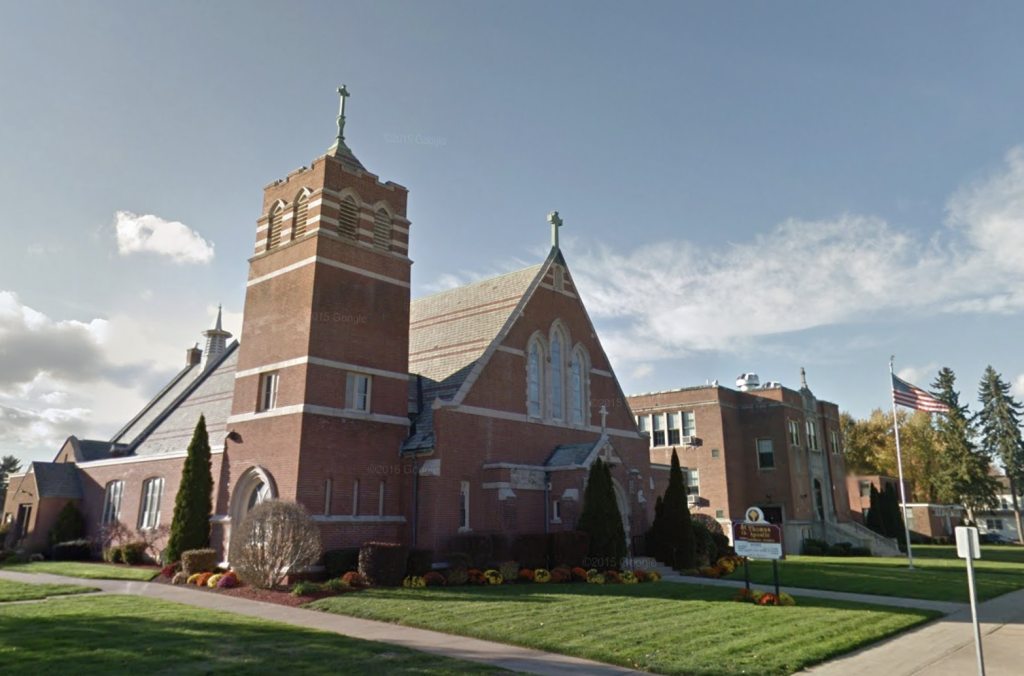
Podcast for St. Thomas of the Apostle Parish.
Episodes
Saturday Jul 25, 2020
Saturday Jul 25, 2020
Our Gospel passage today gives us a glimpse of the human tendency to seek status and importance. In the instance we witness today, we see that it is the mother of two of Jesus’ disciples who seeks this for her sons. So, we understand that sometimes, this tendency can be one of pride, if not for ourselves, then for others whom we love. And the offense taken by the other Apostles is just another instance of the tendency to want to appear important in the eyes of others.
We see this tendency so often in the media, in government, and in many areas of life, where people want to appear more important and more powerful than others.
But Jesus works to teach everyone in today’s story that such status-seeking has no place in the lives of any of His disciples; that to truly follow Him, they must drink of the chalice of suffering from which He drinks; that, like Him, they must serve and not seek to be served. Humility and putting others before ourselves are ways to true greatness, the kind of greatness to which we are all called: the greatness of being born in the image of God, following His ways, and returning home to our Father at the end of time, with nothing except the fruits of our actions on earth.+
Friday Jul 24, 2020
Friday Jul 24, 2020
As we know, Jesus often used parables to teach the people about the life of faith and His mission in leading them to the Kingdom of Heaven. In them, he used metaphors to which the people could relate. And, as we see in today’s passage, He explained to His apostles the realities that the metaphors represented.
In explaining the Parable of the Sower, Jesus emphasizes the various types of soil on which the seed falls. The metaphor stands for how the people who hear the Word of God receive it. Some never accept the Word; others believe for a short time, but fall away because of criticism of their faith; others believe, but the Word is choked by worldly anxiety and the seduction of riches; others respond to the Word and produce fruit abundantly.
Let us pray that we may always be the fertile soil upon which the seed of God’s Word falls and that we will take that Word to heart and share it with others by our words, actions, and attitudes.+
Thursday Jul 23, 2020
Thursday Jul 23, 2020
You can lead a horse to water, but you cannot make it drink. It is said that this is the oldest continuously used proverb in the English-speaking world, first appearing in writing in the year 1175. So, it would seem that there is a lot of veracity to what it refers to; namely, that we can lead people to the truth, but we cannot make them hear it, or see it, or believe it.
It can be argued that Jesus was saying this about some of the prophets and righteous people of His day and in the ancient days as well, given His quoting the prophet Isaiah in today’s gospel passage.
Jesus’ parables were tools He used to give people a window, a way to recognize and understand the Truth that He came to bring us. All of us have a deaf ear and a blind eye to different areas of our lives, even facets of our lives that are very important to us. And there are many different reasons why this is the case and those reasons are different for each person.
So, let us acknowledge that we are sometimes blind and deaf to the message and presence of Jesus in our lives, and ask the Holy Spirit to help us to hear, to see, and to believe the Truth.+
Wednesday Jul 22, 2020
Wednesday Jul 22, 2020
In the long tradition of the Church, including its artistic tradition, Mary Magdalene has generally been portrayed as a repentant sinner. This is largely due to her being mistakenly identified with the sinful woman who washed the feet of Jesus with her tears and dried them with her hair. In reality, there is no evidence to suggest in the Gospels that Mary was any more a sinner than the other disciples of Jesus. Our Gospel passage today identifies her as the woman whose devotion to Jesus brought her to the tomb early on that first Sunday morning. Her sincere devotion to Jesus also left her outside the tomb weeping tears of loss when she discovered the body of Jesus was not there.
Mary Magdalene sought the LORD but could not find Him. However, the Lord came seeking her and found her when He called her by her name. Like her, we too seek the Lord, and, like her, we are also being sought and found by Jesus. Indeed, our LORD'S search for us comes before our search for Him. Even if we struggle to make our way to the LORD, like Mary, the LORD always makes His way to us and calls us by our name. He is the Good Shepherd who, having laid down His life for us, now calls us by name.
In calling us to Himself by name, the LORD also sends us out, as he sent out Mary Magdalene, to bring the Good News of His Risen presence to those we meet. The LORD who calls us by name also asks us to be His messengers to others.+
Tuesday Jul 21, 2020
Tuesday Jul 21, 2020
For most of us, the thing we value most on this earth is our family. As we get older, we might not see our family members as often as we once did, but they still matter a great deal to us. They say “blood is thicker than water.” When a family member is in difficulty, we will generally gather around them to give support.
The Gospels don’t really tell us a great deal about Jesus’ family. Yet, when they do mention His family, they give the impression that there was often a certain tension between Jesus and His blood family.
In this morning’s Gospel, Jesus’ family, including His mother, were standing outside where Jesus was speaking, anxious to have a word with Him. They were trying to get His attention, perhaps even trying to get Him home, away from the crowds that were always pursuing him.
However, on this occasion Jesus stood His ground; he didn’t go with His family. Rather, He redefined who his family really was. He identifies His disciples as His family, and He declares that all those who do the will of His heavenly Father are now His family.
As disciples of Jesus, we are all brothers and sisters of the LORD, and of each other, and sons and daughters of God as well. This is the new family that Jesus came to form, and what distinguishes this family is the desire to do the will of God as Jesus has revealed that to us by His words and by His life. That is why, together, as members of the LORD’S family, we pray, “Thy will be done, on earth as it is in heaven.”+
Monday Jul 20, 2020
Monday Jul 20, 2020
In today’s Gospel passage from St. Matthew, Jesus mentions two prominent figures from Judaism’s past: the wise king Solomon and the reluctant prophet Jonah. Jesus goes on to speak of Himself as greater than both Jonah and Solomon. Jesus not only speaks God’s word, but He is also the Word of God; Jesus is not only a wise king, but He is also the Wisdom of God. Yet, despite His true identity, many of Jesus’ contemporaries did not appreciate Him; they want some amazing sign before they will take Him seriously.
What Jesus says to them He says to us as well: “There is something greater than Jonah here; something greater than Solomon here,” (here in this place, wherever we happen to be). Someone more wonderful than all the prophets and wise men of Israel put together is standing among us, is present to us, present within us. Jesus is not only greater than Jonah and Solomon; He is greater than anything that might seem to come between Him and us. As Saint Paul says, “Nothing in all creation will be able to separate us from the love of God in Christ Jesus our Lord.”+
Sunday Jul 19, 2020
Sunday Jul 19, 2020
Most of us don’t remember the first steps we took as toddlers but many of us might remember the first steps we took in learning to read when we were very young. It probably began with a series of cards or posters: A is for apple, B is for ball, C is for cookie. And we would work so hard to learn those sounds. Once we learned to attach those sounds to the particular letter, we were able to identify groups of letters that formed words. And once we were able to "sound out" words we were able to enter the wonderful world of reading. Think about how far we've come since "see Dick and Jane run" was the height of great literature.
And then there was math. First, we had to learn to count to ten, and then we had to recognize that those numbers represented specific numbers of apples, cookies, or pennies. Then we moved on, with the help of pie tins, to fractions.
For those who are or who have been married: Do you remember the first time you met your spouse? Maybe it was a chance meeting with a simple "Hello," a few awkward words might have been exchanged, then you worked up your courage to ask for your first real date, and somehow, you connected -- a relationship began, and love blossomed. And it all started with a simple, awkward, "Hello."
The great events and moments of life begin with small things: from simple beginnings and basic ideas begin life's greatest accomplishments and journeys. Humanity's dreams of peace, reconciliation, and justice will be realized, first, in simple, basic, and small acts of goodness of individual men and women. Such is the "mustard seed" of faith: that, from the smallest and humblest acts of justice, kindness, and compassion, the kingdom of God will be realized.
As Christians, each of us is called to help to bring about the Kingdom of God and to lead others to that Kingdom. This is a pretty daunting task, but we need to remember that we are not working on that task alone; we do so with all other people. And we need to remember that it is not all done at once; God’s kingdom is achieved one small step at a time. In an age where we expect things instantly, the idea of one small step at a time seems unbearable but it is the only way that we can truly answer the call to lead others to the kingdom of God. No step is too small; no movement is insignificant.
We pray today and always that we will have the faith, strength, and determination to make each small step on the journey to the kingdom of God. +
Saturday Jul 18, 2020
Saturday Jul 18, 2020
What a difference between those who scheme to destroy Jesus and the attitude of Jesus Himself who came not to destroy but to cure and to heal.
From the earliest days of His ministry, there were those who sought the death to Jesus; Jesus Himself always worked to bring life to others, a share in God’s own life. We hear that “a bruised reed he will not break, a smoldering wick he will not quench.”
The bruised reed and the smoldering wick refer to those who are broken in body and spirit. It is very easy to break a bruised reed and put out a smoldering wick. Those who are broken in body or spirit tend to be very vulnerable. Jesus is sensitive to those who are vulnerable. He can restore the bruised reed and fan into a living flame the smoldering wick.
There are times when we need to come before the LORD in our imperfection and vulnerability and ask Him to renew and strengthen us. Such a prayer to the LORD could take the form of that wonderful prayer for the Holy Spirit we say in our Sequence on Pentecost Sunday:
Come thou Father of the poor! Heal our wounds, our strength renew, On our dryness pour thy dew.
When we are touched by the power of Jesus, the healer and the giver of life, we, in turn, can then become sources of life and healing for others.+
Friday Jul 17, 2020
Friday Jul 17, 2020
The religious leaders in Jesus’ day were far more concerned with the particulars of religious practice than they were with the origin and spiritual meaning of them. This led them to deep mistrust of Jesus and harsh verbal clashes with Him.
As Jesus and his hungry disciples walked through the fields on a Sabbath day, the disciples began to pull off the heads of grain and eat them because they were hungry. In their narrow and unyielding interpretation of the law, the Pharisees saw it as a violation of the rules for keeping the Sabbath.
Jesus did not act against the traditions; in general, He was careful to keep the rules. However, He refuted the objectors on their own grounds by citing biblical passages about David and referring to the work of priests on temple duty. The Scriptures, He said, do not endorse the strict interpretation made by the Pharisees.
If God “wants mercy, not sacrifice,” then the Sabbath is better celebrated by affirming life than by ritual; indeed, life gives ritual its true meaning. The people in the temple, like David or the priests, are more important than the temple itself, so the disciples could act as they did for the sake of life.+
Thursday Jul 16, 2020
Thursday Jul 16, 2020
There is an Arabian fable about a traveler who came upon a fox that had lost its legs. The traveler wondered how the poor creature managed to survive. Then he a tiger approached with meat in its mouth. The tiger ate its fill of the game and then left the rest for the maimed fox.
The next day, the traveler watched as God fed the fox through the same tiger. Marveling at God's generosity to a lowly animal, the man thought, "I too shall rest in the corner of the forest with full trust that the LORD will provide me with all I need."
The man rested by a tree in the wood for many days waiting, but nothing happened. Starving, the man was at death's door when he heard an angel's voice call to him: "Oh, you fool! Open your eyes to the truth. Do not imitate the disabled fox, but embrace the example of the tiger!"
Jesus calls us to take on the "yoke," the "burden," of the tiger, to imitate Christ's example of selfless service and compassion to the hungry, the needy, the challenged in our forests; to be "eagles' wings" for the weary and despairing, the lost and struggling we meet on our journey.
The "yoke" of the Gospel Jesus is "easy" in the joy it brings to the generous heart; it is made "light" by the love of God that such selfless compassion reflects in our own lives and the lives we touch.
Let us pray that we may learn from Jesus' humility of heart and generosity of spirit. By His grace, may we may imitate His selflessness in the compassion and love we extend to the poor, the lost, and the struggling.[1]
[1] Cormier, Jay, Connections, Advent 2006, p. 5