
16.8K
Downloads
1449
Episodes
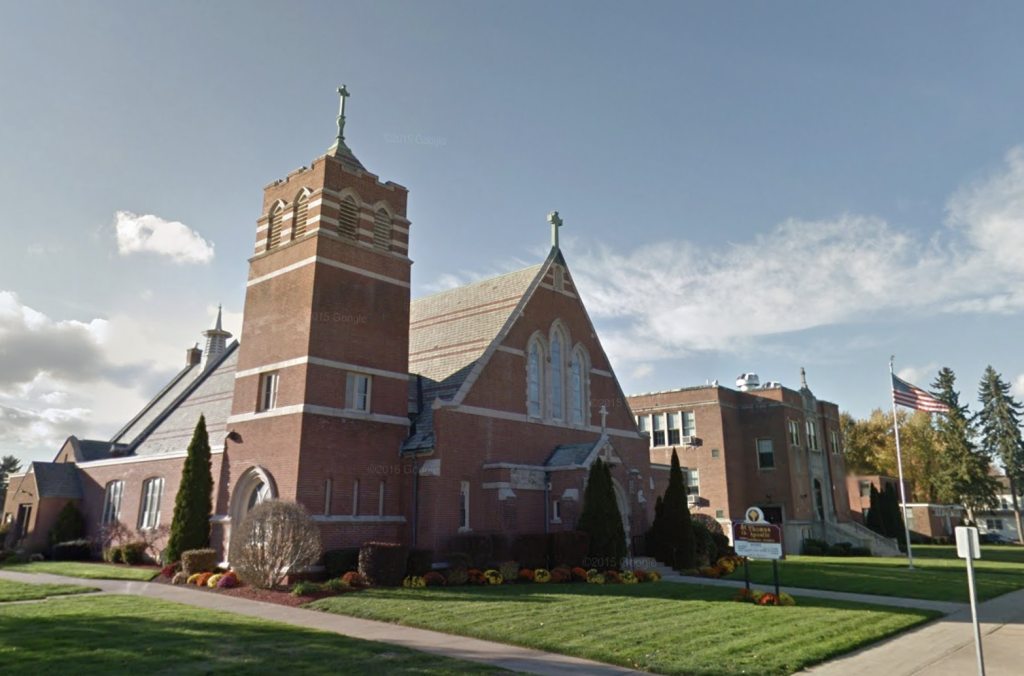
Podcast for St. Thomas of the Apostle Parish.
Episodes
Sunday Jan 31, 2021
Sunday Jan 31, 2021
In 1964 the Romanian government released a number of political prisoners. One was Richard Wurmbrand, a pastor who spent 14 years in prison, 3 of them in solitary confinement.
His cell was a basement room with no windows. A bare bulb illuminated it at all times. His bed was a rough straw mattress on top of three planks.
One night, Wurmbrand was startled by the faint sound of tapping on the wall next to his bed. A new prisoner had arrived in the next cell and was signaling to him. Wurmbrand signaled back. After a while, he realized that the other prisoner was trying to teach him Morse code. Over time, it worked and the prisoner, who was a radio operator, was able to teach him the entire alphabet.
Once he learned the code, Wurmbrand told the radio operator that he was a pastor and asked if he was a Christian. The response was tapped back saying, “I cannot say so.”
Every night the two prisoners communicated through the wall, getting better acquainted. One night, the radio operator tapped out an unexpected message, saying, “I would like to confess my sins.”
The confession took a long time; no detail was left out; nothing was glossed over. It was sincere and from the heart. When the radio operator finished, the pastor tapped back the words of absolution. The radio operator tapped back, saying: “I am happier at this moment than I have been in many years.”
There are two similarities between this story and the account in today’s Gospel. First, in both stories, a man with an “unclean spirit” meets Jesus. In the Gospel, the man meets Jesus in person. In the story of the prisoners, the radio operator meets Jesus through the pastor and the Sacrament of Reconciliation. Recall that Jesus said to those he sent forth in His name, “Whoever receives you receives me,” and “Whoever listens to you listens to me.”
The two stories are also similar in that, in both, Jesus drives out an unclean spirit. In the Gospel, He does this directly saying, “Come out of the man!” In the story of the two prisoners, He does this through the words of absolution: “Your sins are forgiven.” Recall that Jesus told those that he sent forth, “Whose sins you forgive are forgiven them.”
Each one of us, by virtue of our human nature, has some degree of an unclean spirit within us; we have something in us that keeps us from really being the kind of people God made us to be.
Just as Jesus drove out the unclean spirit from the man in our Gospel, and from the prisoner, so does Jesus desire to drive out any unclean spirit that dwells in us.
Jesus wants to free us from that which keeps us from being all that we can be. He wants to free us from whatever is keeping us from being as prayerful, as loving, or as generous as we want to be. But He can do this only if we truly open our hearts to Him; if we are truly repentant in seeking transformation in our lives and in our souls. This we are offered in the Sacrament of Reconciliation: a sacrament in which we experience the forgiveness of God and are given opportunity after opportunity to live the kind of lives we were meant to live; to be the kind of people God made us to be and that we want to be.[1]
If we accept Jesus’ invitation given to us so freely in the Sacrament of Reconciliation, then He will do for us what He did for the man in the Gospel and for the radio prisoner: He will take from our hearts any unclean spirit and replace it with the Holy Spirit.
And so, we pray: "Come, Holy Spirit, fill the hearts of your faithful and kindle in us the fire of your love. Send forth your Spirit and we shall be created, and you shall renew the face of the earth."
[1] Link, Mark, Illustrated Sunday Homilies, Tabor Publishing, 1990.
Saturday Jan 30, 2021
Saturday Jan 30, 2021
The words Jesus addresses to the sea can be addressed to us as well: Quiet! Be still! In our sometimes-stormy lives, we must set aside some time and space for quiet and stillness so that we may hear the voice of the Spirit, to reset our compass as we navigate life's "stormy seas," to check our bearings to ensure that we are living our lives in the hope and joy in which God created us to live them.
We need moments of stillness to reclaim control of our lives and to give ourselves back to God, the Giver of life, the Author of love, the Father of all that is good.[1]
[1] Cormier, Jay, Connections, June 2003, p.4
Friday Jan 29, 2021
Friday Jan 29, 2021
Once again, this morning, we hear Jesus telling people something very important in parables, in simple words and metaphors with which they are familiar and that lead them to understand a deeper reality; a deeper truth about God.
Today, He uses the metaphor of a tiny seed growing into the largest of plants, providing much room and shade to provide shelter for numerous birds of the air. He uses this part of life, with which the people are quite familiar, to describe the kingdom of God.
As the Church, the Body of Christ on earth, we are called – collectively and individually – to be a part of building up the kingdom of God on earth. We are called to take our seeds, that is, our gifts, talents, and skills, no matter how small, and to plant them in our world, and to let the grace of God give strength to our efforts to bring about the kingdom of God.+
Thursday Jan 28, 2021
Thursday Jan 28, 2021
We must listen very carefully to what Jesus says, “Take care what you hear.” There are so many things that we hear, but we do not always pay attention to or take notice of what we hear. Just as there is often more to someone than meets the eye, so there can be more to what someone says than meets the ear. When we listen attentively, we can often hear more in what someone says that may not be immediately obvious to a less-than-attentive ear.
That which applies to our ordinary conversations applies, even more, when the LORD’S Word is spoken. There is always more to the Word of the LORD than first meets the ear. Jesus declares in the Gospel that the more carefully we listen, the more we will receive, “The measure with which you measure will be measured out to you, and still more will be given to you.” The riches contained within the LORD’S words are plentiful and He is generous with them, but it is our generosity, our generous and attentive listening, that allows those riches to be released into our lives.+
Wednesday Jan 27, 2021
Wednesday Jan 27, 2021
Today’s parable was originally meant as an encouraging word from Jesus to His followers. In His public ministry before this parable, Jesus and His disciples met many difficulties and obstacles: The religious leaders accused them of breaking the Sabbath. They even claimed that Jesus had healed people by the power of Satan! Jesus’ own relatives wanted to confine Him to the house because they feared He had lost control of Himself. That was the context for Jesus talking about the farmer sowing his seed in the field.
The Galilean farmer had all kinds of obstacles to deal with, so that many of the seeds he sowed never took root, or never reached maturity. Yet, despite all challenges, obstacles, and setbacks, the harvest turned out to be great. Jesus’ message is this: “Look beyond the obstacles, the setbacks, the disappointments; God is at work in My ministry and the harvest will be great in the end.”
We can all become absorbed by what is not going well, by the failures and the losses all around us. Today’s parable encourages us to stay hopeful in the midst of loss and failure, because the LORD is always at work in a life-giving way, even when failure and loss seem to dominate our vision of the world.+
Tuesday Jan 26, 2021
Tuesday Jan 26, 2021
In today’s gospel passage, Mark describes Mary and other members of Jesus’ family as acting out of genuine concern for Him. However, the fact that we do something out of concern for someone doesn’t necessarily mean that it is the right thing to do. On this occasion, Jesus kept His distance from His mother and the other members of His family, despite their good intentions. When word came to Him that His mother and brothers and sisters were outside the house looking for Him, He said that those inside the house — His disciples — were His real family. There was an implied invitation to His mother and other family members to come inside and to become part of His new family.
Whoever does the will of God, we are promised, is Jesus’ brother and sister and mother. Mary and the other family members had to learn to set aside their own plans for Jesus and to yield to God’s will for Him. It is perhaps reassuring to be reminded that even for our Blessed Mother it was a struggle to live out the implications of the prayer, “Thy will be done on earth as in heaven.”
It is a daily struggle for all of us to give priority to what God wants, but it is a worthwhile effort; it is the Christian effort, and in that struggle, we are assured of the help of Jesus and Mary.+
Monday Jan 25, 2021
Monday Jan 25, 2021
Today we celebrate the conversion of the Pharisee named Saul who became an Apostle of Jesus and was then called Paul.
As a Pharisee, Saul studied and knew all about the events of Jesus’ life and death; he knew that Jesus’ followers recognized Him as the Messiah and that the Mosaic Law was no longer viewed as the final word of authority, that the people believed the life, death, and Resurrection of Jesus was now a part of the final word. As a Pharisee, focused entirely on the Law, this was abhorrent to him.
Yet, somehow, on the road to Damascus, Saul saw Jesus not through the eyes of a Pharisee, but through the eyes of faith, and his view of Jesus was turned completely upside down.
This new view of the one now called Paul enabled him to set aside his blinding adherence to the strictest interpretation of the Law and to recognize Jesus as the Messiah and to become His follower. It also helped him to see that the call to preach, meant the call to preach to everyone, including the Gentiles, whom some early Jewish Christians believed were to be excluded.
Let us pray that we, too, will recognize the presence of Jesus in our lives and that we will also answer the call to share our knowledge and love of God with others.+
Sunday Jan 24, 2021
Sunday Jan 24, 2021
Leo Tolstoy tells a story that begins with the imminent death of a 70-year-old sinner. The man has never done a good deed in his life, and only with his last words did he ask the LORD for forgiveness.
When the man dies his soul comes before the gates of Heaven, but they are locked. The man knocks and knocks at the gates, but to no avail. Finally, the Accuser decrees that such a sinner cannot enter Heaven, and all the man's sins are recited. The sinner begs to be let in, but Peter the Apostle explains that such a sinner cannot be allowed in. The sinner points out that for all of Peter's virtue, he still sinned by denying Christ. He is still not let in.
The sinner continues his knocking and is again met by his list of sins by the Accuser. Now King David explains that such a sinner cannot be allowed in. The sinner points out that for all of David's virtue, he still sinned by committing adultery. He is still not let in.
The sinner continues his knocking and now is spoken to by John the Apostle. The sinner pleads with John, saying, “Was it not you, John the Divine who wrote that God is Love, and that he who loves not, knows not God? And in your old age did you not say: ‘Love one another." How, then, can you look on me with hatred, and drive me away? Either you must renounce what you have said, or loving me, must let me enter the kingdom of heaven.'
And the gates of Paradise opened, and John embraced the repentant sinner and took him into the kingdom of heaven.
Our Scripture readings today focus on repentance, which has the utmost power in our lives. Repentance, a sincere sorrow for our sins, is so powerful because it opens us up to the forgiving power of God in our lives. Through repentant hearts, we receive forgiveness from God and others and we are transformed by that forgiveness. Without repentance, God’s forgiveness, which is always being offered up, has no way into our hearts; it has nowhere to go; it has no real power in our lives.
Repentance is not just being sorry for our sins; it’s seeking to become all that we were meant to be in life. It’s opening our hearts to God’s forgiveness, and God’s love, and God’s transforming power to help us to reach all that we were made for in this life. It’s much more than guilt and it’s much more than the desire to be free from guilt. It’s the desire, the yearning, to be whole, to be filled with the love of God, and to follow the will of God in our lives. It’s the longing to be new once again. Each one of us has the potential to be transformed, to be re-formed.
There is a story about Leonardo da Vinci when he was painting “The Lord’s Supper.” He chose an attractive young man named Pietri Bandinelli to be his model for Jesus in the painting.
The complete work took several years to finish. The final character was Judas, and da Vinci went into the slums and all of the “dives” in town looking for someone who would serve as a model for Judas. He was looking for someone who would stand out as such in any gathering.
He found the perfect man, one who was depraved and vicious-looking. Later, as he was painting, Leonardo sensed that there was something familiar about the man, and finally he asked if they had ever met before. “Yes, we have,” replied the man, “but much has happened in my life since then.” He said that his name was Bandinelli, that it was he who was the model for Jesus several years before.
It is important to remember that the reverse can be true, that this man could have been painted as Judas first, and later transformed into a model for Jesus. After all, a saint is simply a sinner whom Jesus has saved and sanctified. But, while Jesus is always offering this to us, the process takes place only in the repentant heart of a sinner[1]; we need to cooperate with the grace of God. May our hearts, through a true sense of repentance and a true desire to reform our lives, be open to and transformed by the saving grace of Jesus Christ.
[1] McArdle, Jack, 150 More Stories for Preachers and Teachers, Twenty-Third Publications, Mystic, CT, 1996, p. 87.
Saturday Jan 23, 2021
Saturday Jan 23, 2021
St. Mark strongly infers that many people did not understand Jesus during His public ministry. One question that keeps coming up in one way or another is, "Who then is this?"
In today's notably short Gospel reading, it is evident that even Jesus' relatives do not understand Him or what He is doing. When the demands placed upon Jesus stop Him from eating properly, St. Mark tells us that His relatives attempt to take control of Him, certain that "He is out of his mind." They would soon learn that He would not allow His relatives to control Him.
Jesus was doing His heavenly Father's work, and part of that work was to form a new family, a family of disciples, brothers and sisters of Jesus, sons and daughters of the Father. Jesus' own natural family, his relatives, would have to learn to accept that.
All of us are members of that new family; we are all the fruit of Jesus' work, a work that people struggled hard to understand at the time. For us who are part of this new family, the question, "Who then is this?" remains a relevant question. We are always struggling to know the Son of God more fully, whose brothers and sisters we have become.+
Friday Jan 22, 2021
Friday Jan 22, 2021
Decisions and actions against human life are influenced by many things: feeling fearful, feeling unsupported, feeling pressured, feeling angry, or feeling alone. All of these feelings lead some people to make decisions that put the lives of others at risk, as well as their own lives.
Consider a college student who has conceived a child in her womb. Her boyfriend tells her that she must choose between him and their unborn child.
Consider expectant parents who have just been told their baby may have a serious disability. Our culture and our laws provide for them to consider a choice to end the child’s life so as to have the baby not suffer or struggle.
The disagreement between those who are “Pro-Life” and those who are “Pro-Choice” elicits very strong feelings on both sides. Nonetheless, we are called to love both the unborn children and their parents, even if they are considering abortion, providing concrete support to help those in difficult pregnancy situations to welcome their children before and after they are born.+