
16.8K
Downloads
1449
Episodes
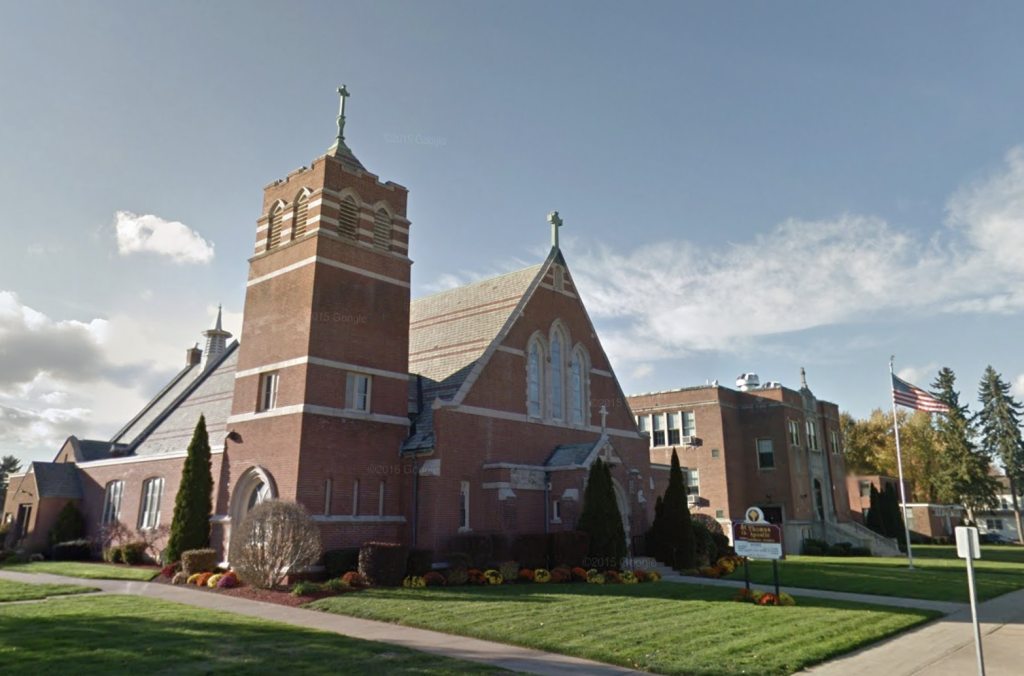
Podcast for St. Thomas of the Apostle Parish.
Episodes
Wednesday Feb 10, 2021
Wednesday Feb 10, 2021
Traditionally, the image of the human heart is the symbol of love. In today's Gospel passage, Jesus gives us a different understanding of the human heart; He says it is the source of evil intentions damaging and destructive of others.
The heart is the person's inner core, and we know that our inner selves have light and darkness; it can be a reservoir for good, and it can be a channel for evil. One of the great images of our faith is the Sacred Heart of Jesus; it was a prominent image in my home growing up and still is today. It was an image that professed that at God's inner core was wholly selfless love, a love that was entirely exposed in the life, death, and resurrection of Jesus. This incredible love is intensely creative and life-giving.
Our calling is to have hearts that, to some degree, reflect the Sacred Heart of Jesus; to have an inner core that participates in God's inner core. This great vision of our central calling is well captured in that simple but profound prayer that many of us learned at some point in time, "Come Holy Spirit, fill the hearts of your faith, and kindle in us the fire of your love." +
Tuesday Feb 09, 2021
Tuesday Feb 09, 2021
Jesus accused His critics of ignoring God's commandments while insisting on adherence to human regulations. Jesus recognized that the religious traditions of His time did not always correspond to God's will as revealed in the Scriptures, and in a much fuller way now by Jesus Himself.
The Church needs to be always alert to ensure that its traditions conform to God's Word to us, especially as spoken by Jesus. Every so often, our Church has to renew itself, with the help of the Holy Spirit, to purify its traditions so that they correspond more closely to the true spirit of the Gospel. We can understand the Council of Vatican II as a significant attempt to do just that.
In our personal lives, too, we can get into traditional ways of doing things that are not in keeping with the core of God's message to us in and through the Scriptures. Our personal tradition, whether it is our religious tradition or our tradition in the broader sense, is always in need of reform in the light of the Gospel. We need to keep on hearing the Word of the LORD afresh, and to invoke the Holy Spirit to help us to do so.+
Monday Feb 08, 2021
Monday Feb 08, 2021
Today’s Gospel passage highlights the incredible popularity of Jesus among the ordinary people of Galilee. He particularly attracted the sick and broken because God’s healing power was so clearly at work through Him. People begged Him to let them touch even the tassel on His cloak, as the woman had done who was healed of her flow of blood. The Gospel says that people were hurrying to bring their sick to Him. The poor and the needy were especially desperate to get to Him and to make contact with Him.
In our own lives, too, it is often in our brokenness and weakness that we seek out the LORD with the greatest sense of urgency. Something happens to us that brings home to us our vulnerability, weakness, and inability to manage things independently.
It is those experiences, when we come face to face with our frailties, that bring home to us our need for the LORD and our dependence on Him. It is often the darker and more painful experiences of life that open us up to the LORD.
When St. Paul was struggling with his “thorn in the flesh,” he heard the Risen LORD say to him, “My power is made perfect in weakness.” Our various experiences of weakness can be like gateways through which we reach out to the LORD, and the LORD comes to us.+
Sunday Feb 07, 2021
Sunday Feb 07, 2021
One hot summer afternoon, a woman was weeding her flower beds and pruning the plants in front of her house. The flowers were especially magnificent.
A passerby said to the woman, "I really like those flowers."
As she wiped the sweat from her face with a dirty hand, the woman's weary response was, "I do, too, but only when they bloom."
The passerby thought about how many people have a similar attitude toward Church, family, work, or life in general – "I only like it when it is in full bloom and beautiful."
The passerby also thought of those necessary times of hard work – mulching, weeding, cultivating, pruning, and transplanting – as well as seasonal dormancy, which are all needed to bring about the blooms which precede the bearing of seeds and fruit.
Our readings today all speak of burdens, of having things to do. Everyone in our readings has some purpose, some task that they are performing. In the Book of Job, the speaker is one who is lamenting his life's labors. St. Paul speaks of the burden of preaching the Gospel that has been "imposed" on him, of the stewardship entrusted to him.
Finally, in our Gospel, we see Jesus laboring for the health and salvation of others. He performs many healings and preaches the Good News. Even the woman he heals gets up and immediately waits on those present.
Our readings give a sense of people who are tired. Even Jesus goes off for rest and prayer after preaching and healing all day and, when his disciples tell him, "Everyone is looking for you." Jesus responds wearily, "Let us go… that I may preach. For this purpose have I come."
Anything worthwhile in life can take a lot of labor and effort. And, at times, it may even seem to be very burdensome. But if we have a sense of why we are doing it and what we will have at the end of our labors, this keeps us going.
In the case of the Gospel, which we are all called to preach, we labor to spread the Good News of God's kingdom to all people. It is a daunting task, especially when people don't want to hear it. And, without seeing much in the way of results, it can seem burdensome. But it is for this purpose that we have come to where we are today. It is for this purpose that we gather for Mass each Sunday. It is for this purpose that we call ourselves Catholic and Christian. It is for this purpose that we live.+
Saturday Feb 06, 2021
Saturday Feb 06, 2021
As we all know, things do not always go the way we had planned. In the morning, we intend to accomplish something before the end of the day, but somehow it does not happen. On a grander scale, we might have had some plan for our lives that has not materialized for whatever reason. Such experiences can cause despair, or we can respond in various ways and move beyond disappointment or frustration.
Jesus' plans for Himself and His followers did not always work out. As we just heard in today's Gospel story, He planned to take them away to a deserted place for a time of quiet prayer and reflection because they had been so busy they barely had time to eat or to pray. However, when they arrived at that deserted place, it had become crowded with people who arrived there before them.
Jesus' response to His plans being hindered was not anger or resentment. Instead, "His heart was moved with pity for them... and He began to teach them many things." His plans needed to be changed because something happened that fit into God's larger plan.
Any time our plans go astray, something better can replace them if we are flexible and open to other possibilities, to something greater than our own will. God's plan is always more crucial than our plans. Whenever we have to put aside our own goals and dreams, we must pray that the LORD's life-giving purpose for our lives will prevail.+
Friday Feb 05, 2021
Friday Feb 05, 2021
The scene that we witness in today’s Gospel passage is one that has inspired artists, authors, and playwrights over the past two millennia. The lavish birthday banquet in Herod’s palace degenerated into a “banquet of death.” Mark follows up this scene with the story about Jesus feeding the multitude in the wilderness. It is as if the writer of this gospel wants to set Herod’s banquet of death against Jesus’ banquet of life.
John the Baptist is described in the gospel as a “good and holy man.” He courageously spoke God’s truth, of God’s way, and that is really why he was beheaded. Of course, Jesus was crucified for the same reason, because He, too, proclaimed the truth and purpose of God’s ways.
We are all called to proclaim the ways of God as revealed to us by Jesus. That will call for courage at times, the courage displayed by John the Baptist and Jesus. One of the traditional seven gifts of the Holy Spirit is courage. Today, more than in the past, it seems, we need a courageous faith; we need the courage of the Holy Spirit to witness to the values and message of the gospel, as did John the Baptist and Jesus.
We need to remember, though, that a courageous faith is not an arrogant faith; it is not a condescending faith; it is not a “Holier-than-Thou” faith. But it is a firm faith, a lasting faith, a faith that holds strong when the storms come because its roots are deep.+
Thursday Feb 04, 2021
Thursday Feb 04, 2021
St. Mark shows how, early into His ministry, Jesus sent out the Twelve that He had chosen to share in His work. He sent them out to do what He had been doing: to preach the gospel and to heal the sick. Jesus understood that He needed the help of others to do the work He had been sent to do. Jesus still needs us today to do His work. We are to be His eyes, His ears, His hands, His feet, His voice, and His presence wherever we are. He wants to work in and through us.
St. Paul understood this very clearly. He saw the Church as the Body of Christ in the world. The Body of Christ cannot be fully functioning unless everyone plays the role they are called and equipped to play through their Baptism. Each has a unique contribution to make to the life of the Body and, thereby, to the work of the LORD in the world today. Each is indispensable and necessary. The first reading from the letter to the Hebrews puts it very simply: In the Church, everyone is a “first-born child” and a “citizen of heaven.” There are to be no second-class citizens in the Church. Each of us is a vital member of Christ’s Body, uniquely graced by the LORD for His work and mission in the world.+
Wednesday Feb 03, 2021
Wednesday Feb 03, 2021
The people of Nazareth should have recognized how God the Father was working through Jesus in a distinctive way. Instead, they sneered at Him and despised him. He was too familiar for them, too local, too known. They knew His mother and His family. As one of their own, he was too ordinary for them to take Him seriously. It is a classic case of “familiarity breeding contempt.”
We often fail to recognize the presence of God in the ordinary and in the familiar. In reality, we do not have to go long distances or witness miracles to recognize the wisdom and the power of God. It is all around us in the near, the familiar, and the ordinary, if we have eyes to see and ears to hear. The Gospel invites us to see the familiar and the ordinary with new eyes. The failure of the people of Nazareth to see in this way inhibited what Jesus could do among them. Our seeing in this way gives the LORD space to work among us in new ways.+
Tuesday Feb 02, 2021
Tuesday Feb 02, 2021
In our gospel reading today, St. Luke tells us about a very joyful day in the city of Jerusalem. A young couple, along with their young son, meet two elderly people named Simeon and Anna. Simeon’s responded to meeting Jesus by praying aloud. Cradling the infant Jesus in his arms, he blessed God in a prayer that has made its way into Compline, the church’s official Night Prayer.
Anna’s response was to tell everyone about Jesus, especially those people who were waiting in hope for a sign of God’s favor.
These two very devout Jewish people of very advanced age embody two fundamental qualities of being aware of the presence of God. Simeon lifted up his heart in prayer, and Anna spoke out about Jesus before others. Simeon’s meeting with the Holy Family led him toward God in prayer; Anna’s meeting with the Holy Family led her to share the Good News. Each of them has something fundamental to teach us about how to welcome the LORD. We are to thank the LORD in prayer and to bear witness to the presence of God in our lives. Like Simeon, we thank God in prayer for the gift of His Son, the Light who enlightens us. Like Anna, we proclaim God’s gift to others, by what we say and do. The LORD who entered His temple as the Light of the World has entered our lives too. Simeon and Anna show us how to respond to His gracious coming.+
Monday Feb 01, 2021
Monday Feb 01, 2021
Our Gospel reading today tells us an unsettling story about a man who was possessed by demons. He was very much out of control, completely separate from himself and from others. He was more dead than alive, as is indicated by his living among the tombs. He was the absolute outsider. Yet, Jesus engaged with him, and, as a result of his encounter, the man was healed and his relationship with his community was restored. Having just calmed a storm at sea, Jesus calmed the storm in this man’s mind and spirit and sent him out as a messenger of good news to his community.
Hopefully, we may never be as troubled as this man was, but we can all find ourselves out of sorts from time to time; out of sorts with ourselves and with others, feeling only half alive within ourselves, tossed and thrown about. It is then that we need to come before the LORD as the man in the gospel did. His initial approach to the LORD was quite aggressive; it was full of anger, “What have you to do with me, Jesus of Nazareth?” Perhaps, when we are distressed, that can also be our starting point when we come before the LORD in prayer. Yet, He is never put off by our disturbance within. If we let Him, He will pour His peace into our hearts; He will calm us as He calmed the storm, and having done so, He will send us out to share His peace and mercy with others, just as He sent out the man in the Gospel.+