
16.8K
Downloads
1458
Episodes
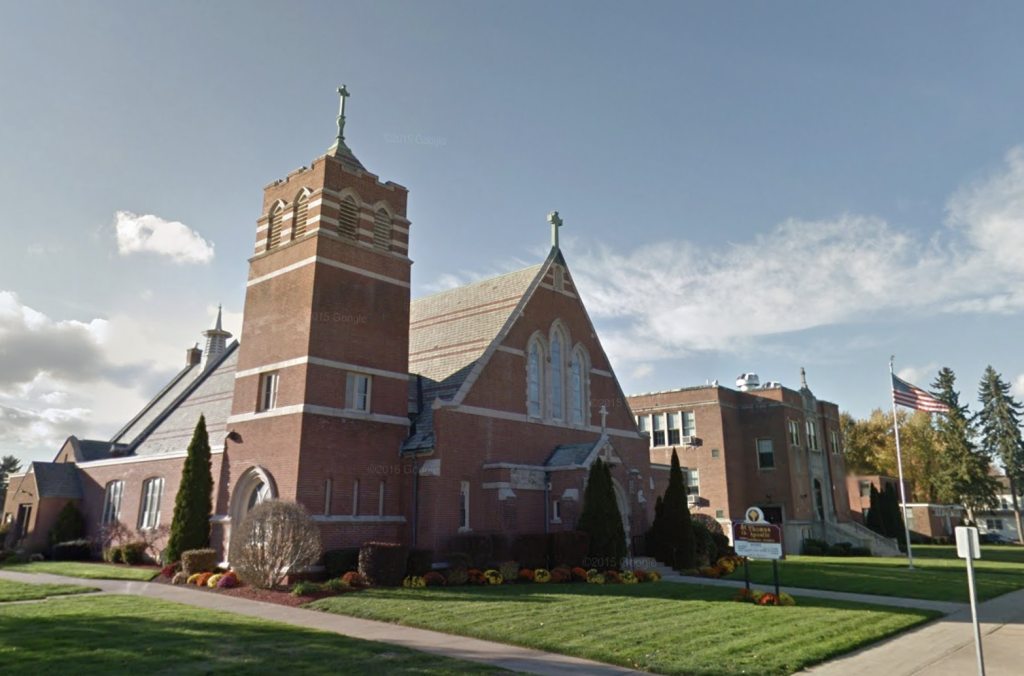
Podcast for St. Thomas of the Apostle Parish.
Episodes
Saturday Dec 14, 2019
Saturday Dec 14, 2019
In today’s Gospel passage, Jesus identified John the Baptist with the prophet Elijah, whose return was anticipated just before the emergence of the long-awaited Savior. Jesus said of John the Baptist, that “they did not recognize him but did to him whatever they pleased.”
John’s fate would soon become the fate of Jesus Himself. As Jesus said, “So also will the Son of Man suffer at their hands.” Both John and Jesus proclaimed the ideals of God’s kingdom and both of them suffered greatly for doing so. Even as we draw nearer to celebrating the birth of Jesus, we are being reminded of the Cross that awaited this Child.
At Christmas, we celebrate the Good News that God so loved the world that He gave us His only Son. Today’s Gospel passage reminds us that God’s giving was a giving-unto-death, a giving that cost no less than everything.
At this time of the year, we pray for this same generosity, so that we may give to others what God has given to us. +
Friday Dec 13, 2019
Friday Dec 13, 2019
Jesus was a careful observer of people and He often spoke about the kingdom of God using everyday images drawn from people’s daily lives. Today we find Him using His observations of children at play in the marketplaces. Sometimes their play simply reflected the joy of life. They happily pretended to play pipes while other children danced to the music. At other times their games reflected the sorrows of life, perhaps what they had seen at the death of an elderly neighbor. Some of the children sang dirges while the others mourned and wailed in response. But some children refused to join in any game; they wouldn’t dance when the pipes were played, and they would not mourn when dirges were sung.
The unresponsive children reminded Jesus of some dour, unresponsive adults; They would neither mourn in response to the grim message of John the Baptist nor dance in response to Jesus’ more joyful message. They dismissed John as possessed and Jesus as a glutton and a drunkard.
It is interesting how our LORD identified His own ministry with the piper and the dance. His life and His message are good news — the Good News of God’s love for us.
We are called to move in unison with the “music” of Jesus, the “music” of His Spirit in our lives. We try to attune ourselves to the LORD’s rhythm and melody and allow it to shape all that we say and do. That is our Advent calling in preparation for our celebration of the birth of Jesus. +
Thursday Dec 12, 2019
Thursday Dec 12, 2019
On a December morning in 1531, an Aztec man named Juan Diego was on his way to church. As he passed a hill at Tepeyac, near present-day Mexico City, Juan heard a voice calling him by name. Looking up, he was surprised to see what appeared to be a young Aztec woman. She told him to go to the bishop and to tell him to build a shrine on the hill, the site of an ancient Nahuatl shrine. The bishop ignored to Juan.
In her second appearance, the woman identified herself as the Mother of God and she told Juan to go back to the bishop with her request. Again, the bishop rejected the idea.
In her third appearance, she instructed Juan to gather a bouquet of roses, which were growing, out of season, at her feet. So, Juan gathered up the roses in his cloak and brought the roses to the bishop. When he opened up his cloak to present the flowers, both the bishop and Juan Diego were amazed to see, imprinted on the fabric of the cloak, a full-color image of the woman Juan Diego had seen.
That is the story of Our Lady of Guadalupe, the feast we celebrate today. But the apparition was also a turning point for the Church in the Americas. The apparitions took place ten years after the conquest of Mexico by the Spanish in 1521. Christianity was the religion of the conquerors but offered little to the native people.
All that changed after Guadalupe. Mary spoke to Juan not in Spanish but in Nahuatl, Juan’s native language. She seemed to be one of them and all the symbolism she appeared in spoke to the native people. She said that she wanted her shrine to give forth all of her love and compassion to the inhabitants of that land
Mary’s appearance was an experience of conversion: Within six years of the apparitions, nine million Aztecs were baptized. It was also a moment of conversion for the Church itself: The Church became the Church of the poor and oppressed and was no longer the religious arm of the conqueror but the voice of God’s justice and compassion. +
Wednesday Dec 11, 2019
Wednesday Dec 11, 2019
We can be burdened for all kinds of reasons: being overtired, overworked, a marriage in trouble, ill health, and numerous other difficulties in our lives.
Jesus spoke words of hope to people burdened by the demands of the Jewish Law; for in failing to observe them they often felt marginalized. He did not offer them a new law. Rather, he offered Himself as their guide to life. He called them to learn from Him. “Come to me,” He said, and “learn from me.” We learn from His example as well as His words. His teaching is clearly visible in who He was (and is) and how He lived.
To learn from someone, we should spend time with them. In saying, “Come,” Jesus is really saying, “Come and stay.” We are called into a friendship with Him. It is in being with Him that we learn to live as we ought to live. If we come to Him and remain with Him, we will find that his yoke is easy, and his burden is light.
The way of the Gospel is demanding, but our relationship with Jesus makes it much less demanding than it would otherwise be. St. Paul assures us that God’s power at work within us is “able to accomplish immeasurably far more than all we can ask or imagine.” It is by remaining in Jesus, as branches in the vine that our lives will flourish and bear much fruit. +
Tuesday Dec 10, 2019
Tuesday Dec 10, 2019
The decision of the shepherd in today’s Gospel passage seems unrealistic or even foolish. He left ninety-nine sheep on the hillside and went off searching for one sheep that had wandered off and, perhaps, into danger. Why would the shepherd leave the rest of the flock untended and in danger, to go off in search of the lost one? Why would he risk the ninety-nine for the sake of one that went astray? The attitude of the shepherd is the opposite of that of Caiaphas the high priest “who had counseled the Jews that it was better that one man should die rather than the people.”
The shepherd in today’s parable did not share that practical outlook. The shepherd was an image of God, and indeed of the caring outlook of Jesus Himself. God in Jesus is concerned about the lost one. The LORD values each one of us; He calls each one of us by name; none of us is worthless in His sight. He cares equally for each one of us.
Let us pray that we may value ourselves and each other as much as the LORD values each of us. +
Monday Dec 09, 2019
Monday Dec 09, 2019
A few years ago, a parish in Iowa was celebrating its 150th anniversary. While the people were milling about, Megan, who was about 12, carried her baby sister Anika over to the priest. The priest said, "What a beautiful child!" Megan said, "Yeah, Father, but she has a temper." Megan was speaking out of her wisdom. She was learning something we all know: There is a difference between how things look and how they really are.
Today we celebrate Mary’s Immaculate Conception, the first completely holy person. The Greek Fathers say “Panagia,” "the All-Holy," when referring to Mary. Mary's Immaculate Conception is not something we can verify like we can so many other facts; we know this only by faith. Faith is more like wisdom; it is not based on appearances. Faith tells us that no matter how sin abounds in our world, grace super-abounds. Mary’s life is the first occasion of this super-abundance of grace.
Our scientific knowledge can tell us human life began so many thousands or hundreds of thousands of years ago. Our faith tells us that at the beginning God infused his Spirit into that life: His Image right from the moment of conception. Faith also tells us that at the second instance of life there was a fracture: a sin. We pick up on that in today's first reading about Adam and Eve. This reading is chosen for today's feast day because right in the heart of sin is a promise of redemption. Mary is the firstborn of this redemption. Her life is a prophecy of what is hidden in all life. +
Sunday Dec 08, 2019
Sunday Dec 08, 2019
One of the great musical treasures of the Christmas season is Handel’s Messiah, with its soaring Hallelujah Chorus. The story of how the work came to be is as inspiring as the music itself.
The German-born George Frederick Handel was the most famous musician of his time. After enjoying great success writing and staging operas in Germany and Italy, Handel, not yet 30, was appointed the director of London’s Royal Academy of Music. A huge man with an explosive ego, he churned out more than 40 lively operas in 25 years. But, as happens, the public eventually grew tired of opera and sought other diversions. One after another, his operas failed. At the age of 52, deeply in debt and exhausted, Handel suffered a paralyzing stroke.
At this lowest point in his life and career, Handel was asked to write an oratorio for a charity concert in Dublin. Though the commission paid a pittance, Handel accepted. A friend had written a libretto for a meditation on the life of Christ, based on verses from the Old and New Testaments. Always a prodigious worker, Handel found in the project new energy and vision. He completed the work in only 24 days. Handel himself was surprised at what he had written. “I think,” he said, “that God has visited me.” The composer refused the small token commission he was offered.
Messiah was performed for the first time on April 13, 1742, to great acclaim. When Handel tried to stage a performance in London, the clergy denounced it as a sacrilege and blasphemy. So, Handel decided to give Messiah away again. He staged the oratorio as a charity concert for London’s Foundling Hospital. It was so well received that Handel staged it again the next year, and the next, and the next. Every year, until his death at the age of 74, Handel would rehearse and conduct Messiah for the hospital. Twenty-five years after his death, Messiah was finally performed in a church: Westminster Abbey, where the clergy had once raged against it.
The oratorio’s popularity grew — but Handel never realized a penny’s profit from it. Handel’s greatest work was the one he gave away.
In his skill as a musician and his generosity of heart, George Frederick Handel and Messiah mirror the conversion that St. John the Baptist proclaims each Advent with his cries of straightening out crooked paths and making rough ways smooth for our Messiah.
The many elements of our Christmas celebration mean little unless they point to the Christ who comes to reconcile us to God and to one another; the Christ who illuminates our spirits with the light of God’s love and compassion; the Christ who teaches us the ways of the Father’s justice and peace. May our rituals and music, our gifts and kindnesses this Christmas be the road that we build to welcome the Messiah into our homes and into our hearts. +
Saturday Dec 07, 2019
Saturday Dec 07, 2019
Although we believe that Jesus was like us in all things, except for sin, the Gospels rarely refer to the emotions of Jesus. Today, however, Matthew notes that when Jesus saw the crowds, “His heart was filled with pity for them because they were troubled and abandoned, like sheep without a shepherd.”
Compassion happens when we resonate or identify with the needs of others and are moved to action. Jesus’ compassion for the crowd expressed itself in two ways in the gospel: First, He told His disciples to pray that God would send workers into His harvest. The troubled and abandoned people needed workers to journey with them and to lead them.
Second, Jesus appointed some workers Himself. He summoned twelve of His disciples and instructed them to proclaim His own life-giving message and presence to others.
Do we recognize ourselves in today’s Gospel reading? With whom in this reading do we identify?
Perhaps, sometimes, we may be among those who are troubled and abandoned. For those times, today’s Gospel reassures us that the LORD is with us in our time of distress; He is always drawing near to us in His compassion.
At other times we may be among the workers whom the LORD sends forth into His harvest to journey with those who troubled and abandoned. In those times, the Gospel assures us that, in sending us, the LORD will also empower us for the work He is asking us to do.
Let us pray, then, that, regardless of our situation in life, we may always feel the LORD’s presence within us and around us, and that we may both experience and share with others the compassion of the LORD. +
Friday Dec 06, 2019
Friday Dec 06, 2019
The persistence of the two blind men was incredible. They didn’t simply approach Jesus and ask Him to heal them. Rather, while Jesus passing by, they began following Him crying out to Him, “Son of David, have pity on us!”
When Jesus reached the house to which he was going, they approached Him and He asked them, “Do you believe that I can do this?” Their shout to Him earlier was a prayer of petition, an expression of their faith in Jesus. Their answer to Jesus’ question was another expression of their faith: “Yes, LORD.”
Like the two blind men, we tend to pray most deeply when we are in need. Thankfully, most of us have the gift of sight, but we may have spiritual or emotional blindness. There can be areas of blindness in our lives that need healing; we all struggle with weakness and disability of one kind or another, ways in which we are broken and vulnerable. The example of the two blind men encourages us to keep turning to the LORD in prayer, even when it seems He may not be listening. Ultimately, though, our prayer of faith will not go unanswered. +
Thursday Dec 05, 2019
Thursday Dec 05, 2019
All of us can recognize the weather images that Jesus uses in today’s gospel: “Rains fell, floods came, and the winds blew.” Here in New England, especially this week, we could easily add snow to Jesus’ list, and still understand the message He is giving us.
In addition to storms we experience in our weather, we can also be hit by “storms” of a different kind, regardless of where we live in our world. As individuals, we can find ourselves battling against the elements of life, as we struggle in one way or another.
Jesus warns that all of us will at some time face the “storms of life,” and He wants to help us to get through them. When storms come, will we find ourselves tossed about helplessly, or will we be able to withstand the storms and move through them and beyond them?
Jesus wants to be our rock when the storms come. If we listen to His words and act on those words, we will remain safe even when storms break around us. Jesus brings us back to the basics: the doing of God’s will as He has revealed it to us. If we keep on returning to that focal point, the LORD will see to it that we endure, regardless of the strength of the storm. +