
16.8K
Downloads
1455
Episodes
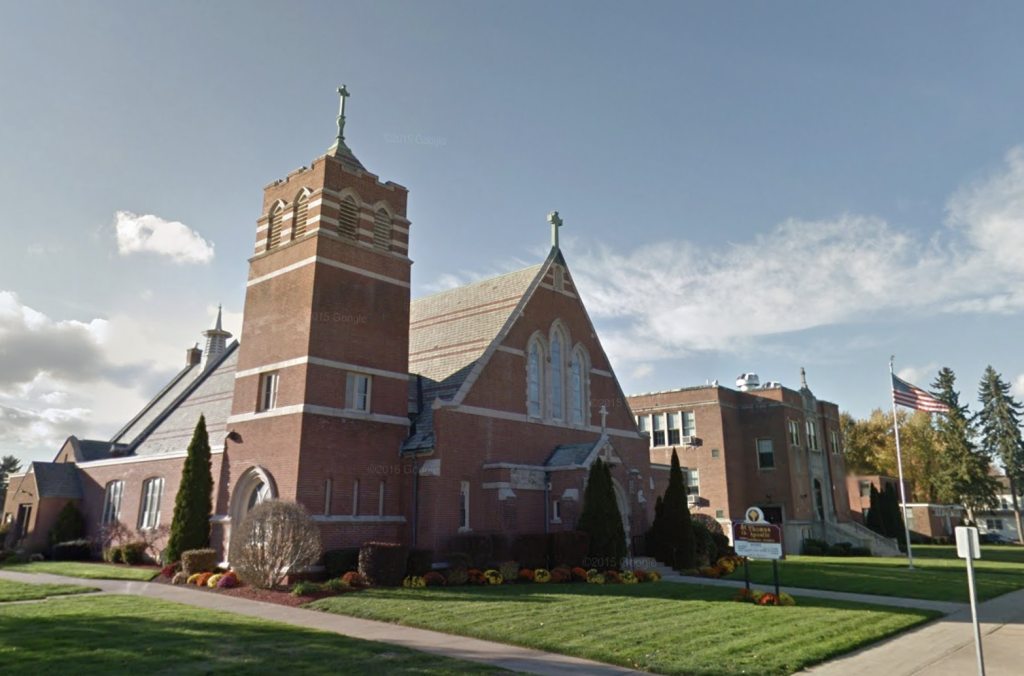
Podcast for St. Thomas of the Apostle Parish.
Episodes
Thursday Apr 16, 2020
Thursday Apr 16, 2020
Thursday Apr 16, 2020
As we just heard, Jesus’ followers had difficulty believing that the man standing before them was the same Jesus they had come to know and love. They believed they were seeing a ghost.
They had been so traumatized by the Crucifixion just a few days earlier, that they struggled to believe that Jesus was really alive. It was too much for them.
Perhaps, even today, we struggle to take in the good news of Easter, to really believe it. It is easier to identify with the death of Jesus than with His Resurrection. We can easily connect with His suffering because of the suffering we experience in our own lives.
Like the disciples, we may stand before the good news of Easter struggling to believe. Maybe that is why we need seven weeks of Easter: to take it all in; to recognize that the Risen LORD is indeed standing among us, saying to us what He said to His disciples, “Peace be with you.”
He offers us that peace of mind and heart, which is the fruit of His love and poured into us by the Holy Spirit.
When we allow ourselves to receive this gift, He sends us out as ambassadors of reconciliation, love, and peace, just as He sent out His disciples nearly 2,000 years ago.
May our hearts be open to the reality of that love so that we may go forth and truly and fully share it with others.+
Just a reminder that St. Thomas has a daily Mass online that posts Monday through Saturday at 8 AM and our LORD’s day Masses post at 4 PM on Saturday and 8 AM on Sunday. The most recent Mass is always available to accommodate your schedule or time preference. Links to the Mass may be found on our website stthomaswestspringfield.org or on our Facebook page: www.facebook.com/stthomas01089
Wednesday Apr 15, 2020
Wednesday Apr 15, 2020
Today’s Gospel passage describes two of Jesus’ disciples walking away from Jerusalem on that first Easter night because the city now had negative memories for them. It was there that Jesus, to whom they had given their lives, was crucified. It was the city that took from them both Jesus and the hopes they had invested in Him. They wanted out, but Jesus had wanted them to remain there.
Although they didn’t realize it yet, Jerusalem was also the city where Jesus was raised from the dead and it would be the place where He would pour out His Holy Spirit upon the disciples. It was the city from which His message would begin to be spread to all the world.
In our Gospel passage, Jesus walked with the two disciples to help them see that there was more to Jerusalem than they realized. In our own lives, it is often the case that the places we flee, whether a physical place or place deep in our souls, when we see them as dreary and dark, are the very places where the seeds of new life grow, and where God is mysteriously but powerfully at work in the darkness.+
Tuesday Apr 14, 2020
Tuesday Apr 14, 2020
Yesterday, we heard Matthew’s version of May’s Magdalene’s experience at the empty tomb on that first Easter morning. Matthew mentioned Mary’s fear but didn’t really go into it. From John, we get a few more details and find that Mary was so upset that she didn’t even recognize Jesus when she first saw Him.
In listening to the Gospels, it’s easy to mistake some of Jesus’ followers as being a little slow on the uptake because we know these stories so well.
Jesus’ followers didn’t know who He really was or what His suffering, death, and Resurrection really meant. In fact, their faith, much like ours, was something that grew slowly, through a process of revelation and moments of discovery.
Despite the fact that we know the story, we, too, can be slow in recognizing the person and presence of Jesus in our lives today. How often, when we are struggling, do we feel alone? How often, when life seems unbearable, do we wonder if God is even there?
Yet, our faith tells us that God is with us at all times, just as the LORD was standing with Mary Magdalene at the empty tomb as she mourned His “absence.”
Let us pray we may be ever-aware of God’s abiding presence in our hearts and in our lives so that, like Mary Magdalene, we may hear the voice of Jesus call to us and bring us to a full awareness of His presence and His love.+
Monday Apr 13, 2020
Monday Apr 13, 2020
It has been said that the truth has a way of bringing out the stuff that people are really made of. Such is the case in our gospel passage this morning as we see two groups of people, each with a different reaction, as they discover the empty tomb.
Mary Magdalene and “the other Mary” saw that the tomb was empty; they saw the Truth of the Resurrection — Jesus Himself — and, although fearful, they went off to proclaim the Truth with joy in their hearts.
The soldiers saw the empty tomb, went to report it to the chief priests and the elders, conjured up a lie with them, and then went on to live their lives in fear that the truth would be exposed: both the Truth of the Resurrection and the truth of their deceit.
As long as we have something to lose, whether it is our social standing, our reputation, our security, our investments, our pride, then we will have difficulty with the Truth. But the Easter greeting of the Risen Christ always assures us that He knows how we feel, and He knows what we truly need.
The Risen LORD wants to calm our hearts with these four words: "Do not be afraid," so that we, too, can proclaim the Truth. The Truth, who is the Risen LORD, will set us free. So, let us not be afraid, Jesus will be with us to conquer all of our fears.+
Sunday Apr 12, 2020
Sunday Apr 12, 2020
On December 6, 1875, the German ship SS Deutschland sank in the North Sea, at Kentish Knock off the coast of England. Among the 157 passengers who died were 5 Franciscan sisters who were traveling to Missouri to begin teaching. The young nuns sacrificed their lives so that others could be rescued. According to one account, the sisters stayed below deck as the ship sank. As the water began rising around them, they were heard praying, "O Christ, O Christ, come quickly!"
The Jesuit poet Gerard Manley Hopkins was deeply moved by the story and he wrote a poem about it entitled The Wreck of the Deutschland, which he dedicated to the five sisters. He saw in their deaths a parallel to the suffering of Christ. Hopkins concludes the poem saying, “Let Him easter in us, be a dayspring to the dimness of us ...”
As used in the poem, the word "easter" is a nautical term meaning to steer a ship toward the east, into the light.
"Let Him easter in us."
Easter as a verb, not simply the name of this great holy day and this holy season that we begin today, not simply the mystery of God's immeasurable redeeming love, but Easter as something we think, as something we feel, as something we do.
"Let Him easter in us" so that we may live our lives in the light of His compassion and peace, in His justice and forgiveness.
"Let Him easter in us" so that we may be of humble service like Him, healers like Him, teachers like Him, foot washers like Him.
"Let Him easter in us" so that we may bear our crosses for one another just as He bore His Cross for us.
"Let Him easter in us" so that, at the end of our voyage, we may "easter" in Him.
Throughout the forty days of Lent, we have been steering our lives toward the light, trying to shake the darkness, the doubts, the burdens of living, the heaviness of hearts, the weight that the pandemic has placed on our lives and in our hearts. When we emerge from the restrictions placed on our lives these past few weeks, we may experience a glimpse of the resurrection to come.
In the meantime, may Easter become a verb in our lives, a way of living, a way of loving, a way of seeing and hearing and understanding. Let us not just celebrate this Easter day, but let us "live" Easter every day. Let us not just mark this event in the life of Jesus, but let this day mark our lives with the compassion, humility, and joy of the Risen LORD.
Let us "easter" through these next weeks and months until we emerge from the darkness the “tombs,” which the scourge of this pandemic has placed us in, and may we live every moment of our lives in the Easter Light of Christ.+
Friday Apr 10, 2020
Friday Apr 10, 2020
A few years ago, a woman was standing outside a church in New York City, hesitating about whether to go inside. Her name was Elaine Pagels, and she was a brilliant historian at Princeton University. Although her specialty was the history of ancient Christianity, it had been years since she herself had gone to church.
Now she was in a desperate frame of mind. Her young son lay in a hospital a few blocks away, just diagnosed with an incurable disease. As she listened to the music drift out of the church and heard the liturgy begin, she found herself drawn in. Writing about this moment in her book Beyond Belief, Pagels said that she was looking for a place to take her fears and grief. Inside the church, she thought, were people who knew “how to deal with death.”
Is that right? Are Christians people who know how to deal with death? Not in the sense that we have knockdown answers to the questions and the terrors that it brings. When the diagnosis comes back with our name on it, when brutal injustice is done to us or our loved ones, our world is shattered like anyone else’s.
What we have, instead of answers, is Jesus Christ. In Him, God was pleased to dwell, and in Him, God Himself entered into the fear and the grief, the questions and the terrors of this life.
This is the amazing, fearful, and saving story that is our Gospel today. Fearful, for this reason: The anointed one of God, God’s beloved Son, did not escape suffering or death, did not escape injustice. As Isaiah says, He was “afflicted,” “pierced,” and “crushed.”
But this fearful story is the saving word to us because of who Christ was and is. Because it was God, the Creator of the universe, who entered completely into this Man’s journey toward death, entered even into the silence of the tomb, then our journey down that same road has to be seen in a new way. Our journey to Good Friday, and through all the Good Friday experiences along the way, is not a journey away from God or a journey away from life but part of the mysterious journey back to God.
This is why Jesus can say on the Cross, in His final moment, “It is finished,” and mean by that not “It is over” but “It is accomplished.” What has been accomplished? The fragile gift of life has been handed back to God.
The other Gospel accounts tell us that Jesus used His moments on the Cross to offer forgiveness to one of the men being executed beside Him and to pray for those who were putting Him to death. The Gospel of John, though, reports that after saying, “It is finished,” Jesus “gave up His spirit.” The Greek words for “gave up His spirit” are sometimes translated “He delivered His spirit” or “He handed over” His spirit. That reading would be consistent with what Jesus is doing in the Gospel of John. He is trustingly handing His life over—not to Pilate or to Caesar but back to God.
Jesus hands His life back to God in a particular way: by first handing it on to others. In the last moments on the Cross, He hands Mary, his mother, and one of the disciples over to each other, creating a new family. He takes their grief and despair and turns it into the occasion for new relationships and new responsibilities.
This act of handing our life back to God is not something we do only at the end of life. It is in the nature of everyday existence. We are always expending ourselves, exerting ourselves. The question is whether we are exerting ourselves only to preserve our life and shore up what we have and our illusions of our immortality. Or, trusting that God is with us in this fleeting life, are we handing on life to others?
The One who went to the Cross, who embraces our life from womb to tomb, calls us to follow Him into the dark uncertainties of this world. In fellowship with Jesus Christ, we can live in a way that hands life back to God by handing it on to others. And then we wait.+
Thursday Apr 09, 2020
Thursday Apr 09, 2020
In our Gospel reading, we witness the scene of Jesus washing the feet of His disciples at the Last Supper. There is an incident from this scene that we don’t see in our reading today, but it is provided for us in Luke’s Gospel and I think most of us are very familiar with it. In the midst of the incredible things that are happening in the Upper Room, some of the disciples begin to participate in a petty – and even childish – argument as to who it is that is greatest among them, and the argument is rather heated.
One has to wonder what Jesus’ inner reaction was to this completely meaningless question of His disciples. Did He shake His head? Did He roll His eyes? Did He bite His tongue? Did He weep or did He laugh because He saw the humor of it? What He did do was to figure that the nonsense of the disciples would give Him a way to teach them. He got up and picked up a towel and wrapped it around His waist. Then He took a pitcher and basin of water and began to wash His disciples’ feet.
As we know, Peter protested. This was because Peter, being the leader, saw the implications; he knew the same would be expected of him. He reacted much the same way we would react when someone of great importance would do something like that. We would shrink away from it. We know that we are supposed to be humble before God, but it is difficult to see our God being humble before us.
This is difficult for us to take for two reasons. First, because we are faced with the fact that God did humble Himself for our sakes. God did this for each one of us. Second, because along with this act of humility, God gave us a command. We are given the command to serve and to break bread and, therefore, to reveal the presence of Christ. This is an awesome responsibility; this is an awesome call. Every time we gather to break the one bread together and to share the one cup, the command is there
This, very simply, is what our Eucharist, our Mass, is all about — the presence of the Almighty in basic bread and the call to be bread to others. To break open the Word of Scripture, to consecrate bread and wine and so to bring Christ among us, both of these, become our comfort and our challenge.
This is what we celebrate on Holy Thursday: The gift of God who gives His Flesh and Blood and, with no apology, gives us the command to do the same.+
Wednesday Apr 08, 2020
Wednesday Apr 08, 2020
During the earliest days of the Church there was no attempt to gloss over the disturbing truth that, in the words of today’s Gospel, Jesus was betrayed by someone who dipped his hand into the dish with Jesus, someone who was an intimate.
The Gospel declares that when Jesus announced that one of those sharing table with Him would betray Him, everyone present was “greatly distressed.” To be betrayed by someone you trust is very distressing for the one betrayed and for all those associated with Him.
Some of us may have had our trust betrayed by people close to us. We confided in someone and they used that information against us.
This week tells us that such betrayal need not have the last word. God the Father had the last word by raising His Son from the dead. He brought good out of the evil of betrayal and the many other evils that Jesus endured. Divine Providence can also bring good out of the negative things we sometimes have to endure from others. The Passion of Jesus compels us to seek to trust that God can work in life-giving ways even after the darkest experiences.+
Tuesday Apr 07, 2020
Tuesday Apr 07, 2020
In his account of the Last Supper, John intertwines two elements: imminent loss and future triumph. Even among those who sat at table with Jesus, there was one who would betray Him and another who would deny Him. He had to struggle with their lack of understanding of what awaited him the next day. But John knew that Jesus faced this supreme trial with a strong hope and willing acceptance. This is also our hope, as we commemorate the sacred events of Holy Week.
The “beloved disciple” seated next to Jesus is an inspirational image of the kind of person we are all called to become. This disciple is not named in John’s gospel, because we are all invited to link our name to his, to identify with him and to learn from him, for we are all called to be beloved disciples of Jesus.+