
16.8K
Downloads
1452
Episodes
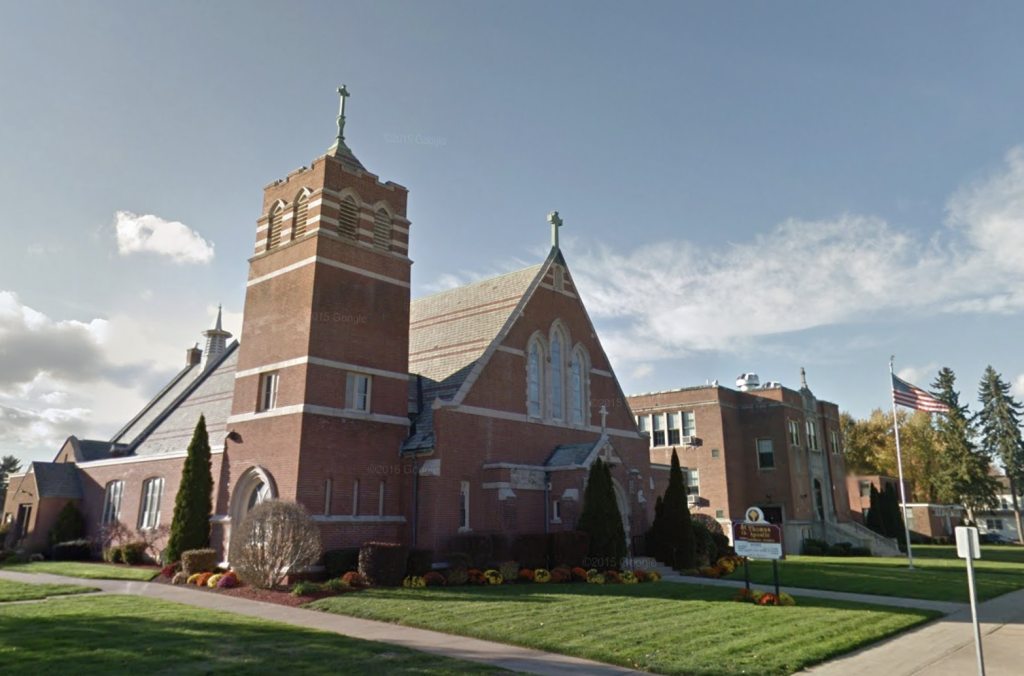
Podcast for St. Thomas of the Apostle Parish.
Episodes
Monday Aug 24, 2020
Monday Aug 24, 2020
St. Bartholomew, whose feast day we celebrate today, lived in the First Century and was one of the Twelve Apostles.
We know little about him from Scripture, except that he is mentioned in Matthew, Mark, and Luke, as well as the Acts of the Apostles as one of the original Twelve. Scripture scholars believe that he was the Nathaniel who was mentioned today’s Gospel passage from John. John said that he was from Cana in Galilee and that Jesus called him a true child of Israel, with no dishonesty in him.
The Roman Martyrology indicates that Bartholomew preached in India as well in Mesopotamia, Persia, and Egypt, and Greater Armenia. It was in the latter that he was scourged and beheaded by King Astyages at Abanopolis on the west coast of the Caspian Sea. and that he also preached in Mesopotamia, Persia, and Egypt.
He is the patron saint of tanners, plasterers, tailors, leatherworkers, bookbinders, farmers, house painters, butchers, and glove makers.
Let us pray… LORD, teach us to treasure, proclaim, and practice the Gospel message of Jesus Christ, which Saint Bartholomew so eloquently preached and finally sealed with his heroic martyrdom. Through his intercession may we be fearless in our expressions of faith and in our desire to bring the faith to others. Through Christ our LORD. Amen.+
Sunday Aug 23, 2020
Sunday Aug 23, 2020
We have all experienced the over-exuberant co-worker or classmate who always has the right answers and, at times, that can be very difficult to stomach.
Consider how the other disciples might have felt towards the overly exuberant Peter. By giving the right answer about Jesus being the Messiah before anyone else, Jesus chose him to hold a special place in the life of the Church for all time. You can be sure that the other disciples believed this was unfair; that they deserved a chance to lead the early Church.
Scriptures abound with evidence that, for whatever reason, God chooses those people who others believe to be weak. Throughout salvation history, there are examples of God singling out one frail person after another to lead the People of God.
Genesis starts with God choosing Abraham, a dying older man, to become the father of a new nation. Some might ask: Wouldn't a healthy and vital person have been a more logical choice? Against cultural tradition, God seems to have a preference for choosing the youngest son for leadership and greatness —Jacob, Joseph, David. Look at the extraordinary characters chosen to be the prophets: Jeremiah, Amos, Hosea, Elisha, and Ezekiel.
If we look at how God chose to live among us, we might ask: Why should God want to take frail human form — and why a simple Galilean peasant in that primitive world of the first century?
As we contemplate that God has chosen us for great things, it is good to reflect on the words of Jesus in John's Gospel when he says, "You did not choose me, but I chose you."
We have a choosing God, who chooses the weak and the strong. The Hebrews certainly had no reason to feel very "chosen" when they were slaving about in Pharaoh's brickyard, but they were. Joseph did not appear very "chosen" when he was sold off into slavery by his brothers, but he was. John the Baptist was undoubtedly "chosen," yet his mission and message kept him first in the wilderness and then in prison.
Each one of us has been chosen as well. God chose us to be the Body of Christ on Earth and to call others to see that they were chosen to be that same Body. However, many things can get in the way and cause us to doubt that God has chosen us for anything.
Can we still feel and see our "chosenness" when our lives seem to be at a standstill? When we have not received a promotion at work that we deserved, can we still congratulate our colleague and know our day is coming? When you're 13, and your face is breaking out, and your voice is cracking, and your body seems to have a mind of its own, can you still rejoice in your humanity, a form that Christ shares with you? When you have retired from your lifelong work and suddenly find your familiar self-identity gone, can you eagerly look forward to God's next call?
God chooses us not just once, but over and over again throughout our lives. God chooses us to help embody the life and mission of the incarnate LORD every day. Our job is to listen for that call, choose to answer it, and act according to it.+
Saturday Aug 22, 2020
Saturday Aug 22, 2020
By the Middle Ages, the Blessed Virgin Mary was venerated as Queen of the angels and the saints. In 1955, Pope Pius XII proclaimed the Queenship of the Blessed Virgin Mary. The feast was given the date of August 22nd to emphasize its connection with the Solemnity of the Assumption, one week earlier.
There are many “vocational stories” throughout the Scriptures. Today we read about the call, the vocation, of Mary, who showed a wide range of responses to her encounter with the angel. First, she was “deeply troubled” at being called “full of grace.” Then she was confused that she would conceive and bear a son. Then, only after reflection, she submitted to what God was asking of her, saying, “May it be done to me according to your word.”
Mary’s question, “How can this be?” shows that she struggled before reaching her famous response. There is always some struggle in reaching our own understanding of what God wants from us. Mary’s response of total surrender to God’s purpose for her life did not come easy to her and does not come easy to us. However, in our struggle to live in harmony with God’s will for us, we have the promise of Gabriel’s words to Mary, “Nothing will be impossible for God.” What seems impossible to us is always possible with God’s help. In the words of St. Paul: “By the grace of God I am what I am, and His grace to me has not been ineffective.”+
Friday Aug 21, 2020
Friday Aug 21, 2020
We are called to be a people of love; to be instruments of God’s love in our world; to speak out against evil and injustice and to do our part to bring peace and justice to our world. This doesn’t mean we condemn others; it means we show others how to love through our example.
In John’s Gospel, Jesus says, “By this, shall [people] know that you are my disciples: if you love one another.”[1]
As we seek to bring today’s Gospel alive in our hearts and in our lives, let us pray that God might let the fire of his love burn brightly in our hearts, so that we might show God’s love to all people and that God’s love will be expressed in our service to one another.+
[1] John 13:35
Thursday Aug 20, 2020
Thursday Aug 20, 2020
Today’s Gospel reading is highly metaphorical. The wedding banquet Jesus speaks of in the parable is symbolic of the kingdom of heaven. Many people have been invited to God’s kingdom, but refused or ignored the invitation. So, God invites us all.
The host of the banquet is clearly upset that one of the guests doesn’t have a wedding garment. That garment is symbolic of the lives we lead. While we are invited to the banquet of heaven, we must adorn our souls with a garment made of faith, love, virtue, adherence to God’s law, service of those in need, a pure heart.
Let us pray that the lives we lead may truly adorn our souls in such a way that we may be as worthy as possible to be granted a place at the table in heaven.+
Wednesday Aug 19, 2020
Wednesday Aug 19, 2020
For many people, today’s parable about the workers in the vineyard is a tough one to swallow. There just doesn't seem to be any fairness to it and yet, this parable isn’t about fairness; it’s about generosity and mercy.
The vineyard owner is, of course, representative of God and we are fortunate that God is like that: generous and compassionate in His love for us. After all, even if we work hard to follow God’s will in our lives, we know that we often fail and it is then that we really don’t want God to judge us with fairness, but with mercy instead.
God's kingdom is His free gift to us. All we can do is love God and our neighbor and trust that He will give us all the graces that we will ever need toward our salvation. Each of us is loved deeply by God, but none of us is able to do anything to have either earned it or demanded it.+
Tuesday Aug 18, 2020
Tuesday Aug 18, 2020
Certain expressions in the Scriptures have an inspirational power about them. For example, it is comforting for us to know that “for God all things are possible.”[1] A similar response is made to answer Mary’s question to the angel, “How can this be?” The angel Gabriel answered, “Nothing will be impossible for God.”[2]
The context in today’s Gospel passage is at the moment that the rich young man, who was looking for the path to eternal life, went away sad because Jesus’ response suggested a sacrifice more significant than the young man believed he could make. How can a rich person find the way to eternal life (presuming that for some rich people, sacrifice is not a doable option)? It is possible, Jesus says, but only with a special grace from God.
All of us, at different times in our lives, face what seem to be impossible odds. We become anxious, wondering how we will get through some health crisis, a family loss, a marriage breakdown, or a severe bout of depression. In such moments, it is good to know that, for God, all things are possible. St. Paul believed this, and he expressed it in his unique way. He wrote, “I have the strength for everything through him who empowers me.”[3] How comforting it would be to share in that deep conviction!
[1] Matthew 19:26
[2] Luke 1:26-38
[3] Philippians 4:13
Monday Aug 17, 2020
Monday Aug 17, 2020
There is something likable about the young man’s pressing question to Jesus in our Gospel passage today, that of a person who seeks ideals by which to live. This young man was sincere about finding spiritual meaning and purpose. It was a vital question, “What good must I do to gain eternal life?”[1] In reply, Jesus recited several commandments, commandments about how to be just and kind to others. The way to eternal life is to be life-giving and law-abiding.
The young man was not satisfied with this answer because he was already doing all of this, and he sensed that there was more that he could be giving of himself. When Jesus revealed what this “more” might be, it seemed to be too much for him; He invited the rich young man to sell his property and give his money to the poor. It was too big a sacrifice, so the young man wilted and went away “grieving”, perhaps wondering what might have been.
Such a challenging, austere lifestyle is not for everyone. Yet, for each of us, the path to life, the path God wants us to follow, will always include some level of self-denial and an unselfish relationship with others. By His teaching and example, Jesus shows us all what we must do to gain eternal life.
[1] Matthew 19:16
Sunday Aug 16, 2020
Sunday Aug 16, 2020
As tradition warrants, crowds at professional baseball games stand up in the middle of the seventh inning to sing “Take Me Out to the Ball Game”. One line from that song stands out to me as I think about the Canaanite woman in today’s Gospel reading: “One, two, three strikes you're out at the old ball game."
The woman already had three strikes against her before she even approached Jesus. Strike one: she was a Canaanite whose people were hostile to the Israelites. Strike two: she was a woman in a male-dominated society. Strike three: she was a Gentile. As far as the disciples were concerned, the Canaanite woman had struck out even before coming to bat.
Jesus’ initial response to the woman seems to say that He agrees with His disciples, who were prejudiced against the Canaanites, that the woman is not worthy of His attention. For us, who understand the nature of Jesus, it is difficult to understand His refusal to deal with the woman; if we acted like that, we would probably be called “unchristian.”
The disciples ask Jesus to send her away, but she is persistent. When Jesus says, "I was sent only to the lost sheep of the house of Israel" and "It is not right to take the food of the children and throw it to the dogs,” we could get the impression that He could also be tainted with such prejudices, but we have to look deeper.
We know that Jesus is truly human and truly God, full of love, mercy, gentleness, and compassion. Jesus has to be faithful to what He is and to what He taught, so there must be more to this Gospel passage than what appears on the surface.
We must presume that, as always, Jesus has a reason for what He is doing. We see in today’s Gospel passage that Jesus deliberately withdrew to Tyre and Sidon, the turf of Gentiles, outcasts and foreigners, hostile to the Jews; a place that would ensure that Jesus’ followers would show their prejudices and expect nothing redeeming from the people in their midst.
Yet, the Canaanite woman acknowledged Jesus as the LORD and Son of David, as one who can heal her daughter. She pays homage to Jesus as LORD, even when the word "dog" is used in a derogatory way to refer to her and her people. She is humble but perseveres in her request even when the disciples want to send her away. She is asking for healing for her daughter more than for herself. She humbles herself more and would eat the scraps that fall from the table of her master. She perseveres in her prayer in spite of the distractions of the disciples. She must be a woman who prays always and well, which generates such great faith. She passes a most rigorous test of faith posed by Jesus who finally says, "O woman, great is your faith! Let it be done for you as you wish."
Jesus heals the Canaanite woman's daughter, a Gentile, a foreigner, and an outcast, showing that healing, reconciliation, grace, and salvation are not exclusively for the Israelites. Everyone is called to salvation into the one family of God including those of other religions, cultures, races, and nations.
The first to learn this were the disciples and so must we, and we must learn to pray like the Canaanite woman. She acknowledged Jesus as LORD full of love, divine mercy, forgiveness, and grace. She was humble and persevered in prayer. She was focused in her prayer and did not allow herself to be distracted while praying.
We should pray always and be blessed with great faith like that of the Canaanite woman. We could begin with a prayer in the morning, at meals, and before going to bed and so sanctify the day. We should return to family prayer. With much prayer and great faith like that of the Canaanite woman, Jesus could say to us, "Great is your faith! Let it be done for you as you wish." Then Jesus will lift everyone off the floor to the table of His altar — to share in the feast of heaven as the one family of God.+
Saturday Aug 15, 2020
Saturday Aug 15, 2020
For most of us, somewhere in our heads is the constant question about what happens after we die. Every religion has to have answers to this ultimate question. Not so much why do we have to die but, what happens after death? Today’s feast is about what happens after death. It is also a key to what is happening in our life.
If you look at Mary's life as recorded in the Gospels there is nothing special about it. It is a life of faith, not vision. It is only Divine Revelation that lets us look at the hidden glory of her life. Revelation tells us that at her death she was assumed body and soul into heaven, the first person to share in the resurrection of Jesus.
Because of Christ's resurrection and Mary's Assumption, we have hope that our death is a beginning, but also that in our life we can look back from that vantage point and find the infinite in the finite. There is so much more going on in our life than we can see or understand or even imagine. When Mary conceived Jesus in her womb, she had a life within her life. Every woman who has conceived must have experienced this—a life within her life. This seems to be a model of Christian life: We have a life within our life. We have the life of God within our life. We have to be attentive to the life we bear, nurture it, and bring forth its fruit. Nothing is as it seems. Death is life, suffering is redemptive, mortality becomes immortality.
St. Thérèse is called the saint of the “little way,” the ordinary way, the nothing special way. One of her biographers says, "The uniqueness of Thérèse's message does not lie in what she confided to her loved ones, but in the fact that she dared to express it at all. Because of this, countless persons realize that this existence of theirs is a ' way' even a way of sanctity.”
Each of us has a “way” of life to be lived. It may not be dramatic, but it is a revelation of God's love for us. When St. Benedict died two monks saw a magnificent road covered with rich carpeting and glittering with thousands of lights. From the monastery, it stretched eastward in a straight line until it reached up into heaven. There in the brightness stood a man who told the monks this is the road taken by St. Benedict. We all have a road to travel, a way. It may seem ordinary but, hopefully, it leads to heaven and, someday, we may be able to look back and see how bright and beautiful the road really was.+